

WHISTLER by Ann Patchett
I'll own my bias upfront about my love of Ann Patchett's writing, but this is another wonderful outing.

I first read Tom Lake almost three years ago and it was the first Ann Patchett novel I’d read. I said at the time it wouldn’t be the last, and it hasn’t been. At the bottom of this review are the links to my other reviews of Patchett’s work. The arrival of Whistler and the timing was, unfortunately, not unlike that of Tom Lake; I read both novels at times of extreme personal grief and both served as wonderful escapism from the sadness that threatened to overwhelm me.
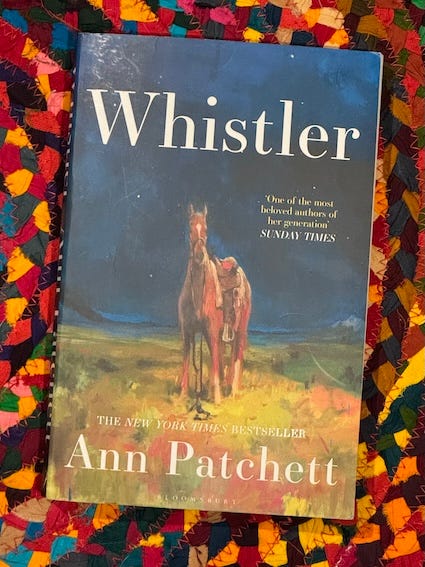
I’ll say from the get-go that Whistler is not going to be my #1 Ann Patchett novel of all time (I think Bel Canto might still have the title) but it is still really wonderful.
Daphne is a teacher in her 50s who, while walking The Met in New York with her husband, the older, retired doctor Jonathan, is followed by an older man. Upon confronting the man, they learn he is Eddie Triplett, who was Daphne’s stepfather for a year or two when she was a child and whom she has not seen since her mother ended the marriage. The divorce comes hot on the heels of a car accident that Eddie and Daphne had, and which Daphne believed was the catalyst for the separation. They were not a family who talked about these things; Abigail never explained why she kicked Eddie out and the girls were too young to ask. By the time they were old enough, they had a new stepfather and a new life, and Abigail wasn’t open to discussing it.
The book tells the story of their reunion and explores the why’s around the end of Eddie’s marriage to Abigail. It’s never controversial - simply an exploration of the relationship between a man and his step-daughters (Daphne has a younger sister, Leda, who is also delighted to reunite with Eddie but whose memories are more scant, given she was only seven when he exited their lives). It’s quickly clear that man and child were very fond of each other back then and that mutual love has not diminished over time; they quickly fall into the rhythm of each other’s lives and there is a delightful normality to it, despite the quite abnormal circumstances.
I think one of the reasons I especially enjoyed this story was that, as a teenager, after my parents’ separation and divorce, my mother was in a relationship with a man named Terry, who my little sister and I really loved. The relationship did not last (like Abigail, at my mother’s behest), but I was able to remain in intermittent contact with him over the years and felt terribly sad when he died a few years ago. So, I felt like I understood how Daphne and Eddie fell quickly into an easy rapport, because when we reconnected, Terry and I always did too.
Whistler is like many of Patchett’s novels, insofar as the story is not one which builds to a crescendo or plot twist. There is an ordinariness in Patchett’s writing - ordinary in the sense that the stories she tells are of characters who are plausible, relatable and pretty normal. The stories themselves are not the sort which feel like they would never happen, or that they couldn’t happen to regular people. There’s an everyday-ness in these stories, and there’s something tremendously comforting about that. There is nothing ordinary in Patchett’s ability to write stories that we connect so intimately. She’s a master of it, and I always know when I crack the spine of a Patchett book, I’m going to have a lot of feelings - but none more than joy. Even the sad ones - there’s just joy in reading an author like her.
Whistler is an objectively joyful book, just like reading Patchett’s work is objectively joyful (for me). I will of course recommend it to all, but that’s a legitimate recommendation - it’s terrific and worth your time.
My other reviews of Ann Patchett novels:


I’ve also read The Dutch House which was fantastic, too!