

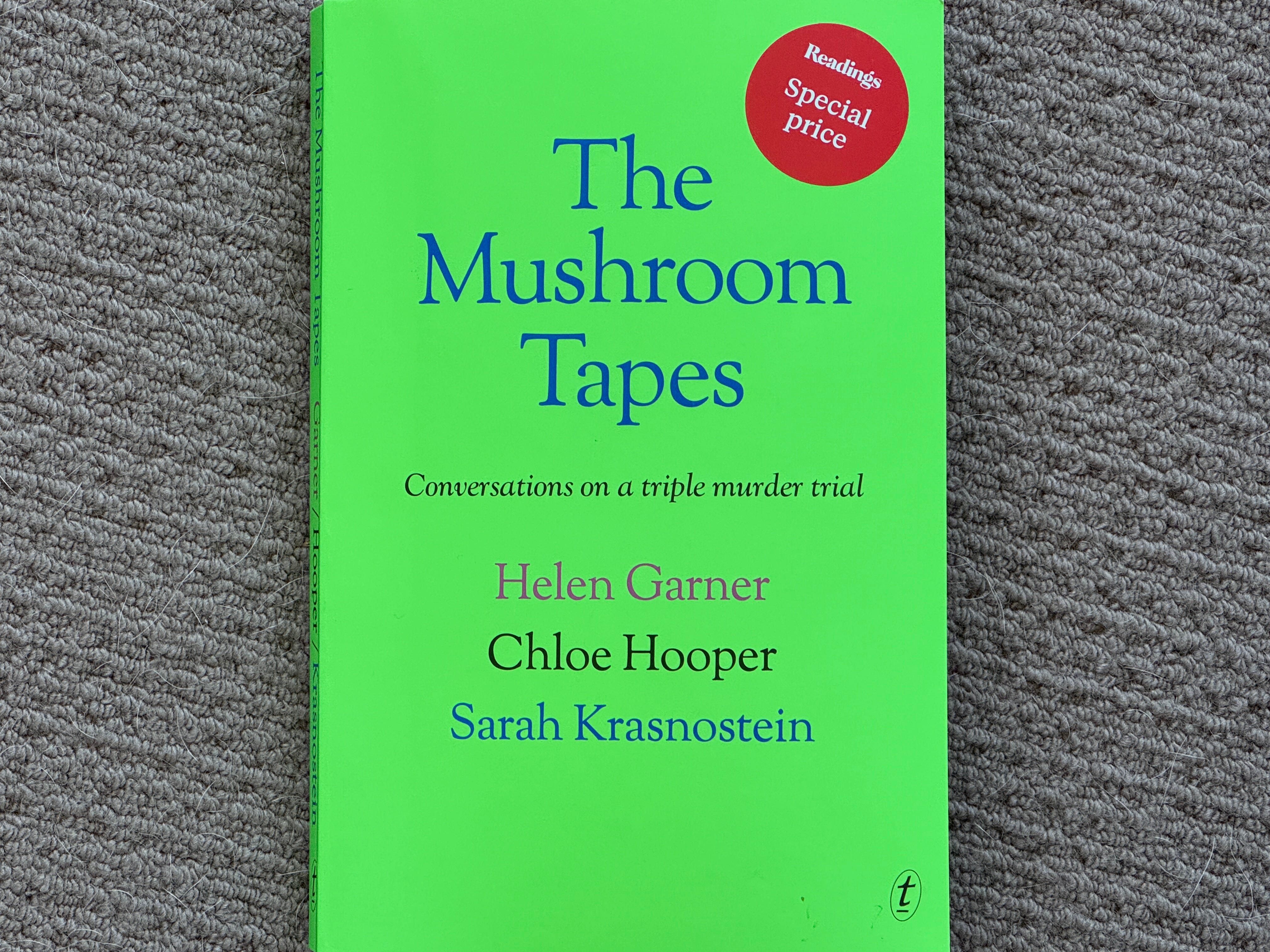
THE MUSHROOM TRIALS: CONVERSATIONSON A TRIPLE MURDER TRIAL by Helen Garner, Chloe Hooper and Sarah Krasnostein
A unique book about a trial that garnered world attention

Certainly in Australia but indeed around the world, you’d probably have to have lived in a cave, under a rock without coming out, to have not heard about the triple murder trial in Victoria, Australia, dubbed The Mushroom Murders.
The case revolved around the poisoning of four people, three of whom died, by the daughter in law of one couple after separating from their son. She invited them to a lunch where she lied to them about having cancer, and served them beef Wellington that was laced with death cap mushrooms.
I have largely stayed clear of the books/documentary/media coverage of the incident, predominantly because it was crystal clear to me that the perpetrator of the murders, a woman and mother a couple of years older than me, was guilty and I am not someone who likes to devote energy to evil. However it was impossible not to know about the case.
This book is a different approach to true crime and by three authors who have significant experience in writing books like these, all of whom are amongst the best in the genre. When I picked the book up at Readings Emporium, I was suprised to find it wasn’t like other books.
The Mushroom Trials is a book largely consisting of transcripts between the three writers, recorded at various junctures of the trial that they were either travelling to Morwell (in country Victoria) for or watching online in the media room at the Supreme Court of Victoria in Melbourne. I believe the initial intent was to create a podcast. There are certainly some additional writing in this book, to give the conversations context, and the book is presented as the conversations occurred - that is, as they were listening to evidence and watching the key players in real time, not knowing what evidence was to come and what was not being presented to the court. I found this fascinating as a writing style - because although I don’t believe any of the three authors genuinely thought there was a possibility of innocence in this case, they were discussing the evidence and the case in real time, rather than retrospectively. It meant that they often came back to previous discussions and thoughts about the case progress and recognise how evidence was being linked together by the Prosecution or question why the defence took the course of action it did.
This results in a relatively quick read: I read The Mushroom Trials in one afternoon/evening (on New Year’s Eve!). It means that there is a lot of speculating and positing by the writers, as they discuss the why of what Erin Patterson did. I am certain that by the end, they have no greater understanding of the woman as a person than before they started, but their attempts to try to intellectually understand her choices were very interesting. All three women writers are highly intelligent and engaged, and Krasnostein’s background as a lawyer offered insight where the other two sought to understand some of the legal decisions being made.
I thought the women treated the trial and the participants with respect and empathy, gave enough detail to understand the social aspects of what surrounded the trial (such as the intense international and local media interest, as well as the true-crime enthusiasts who wanted to watch the trial action) and to get some insight into the people, without making it a reporting exercise. This book casts no real judgment of Patterson, and really they don’t need to. The only opinions that mattered during that trial were those of the jurors, who found her guilty of three counts of murder and one of attempted murder.
Did reading the book make me more empathetic to the woman now in jail for the rest of her life? No. While I could certainly understand her frustration with the difficulties in her marriage and dealing with the approach of the family to it (they are a devout Baptist family who largely stayed out of the weeds on the marriage breakdown), I could not illicit any sympathy for her. She was independently wealthy. She had a home of her own and children she loved. There was absolutely no need to even try to make these people ill and no doubt in my mind that she had a reasonable belief that the mushrooms she served could or would kill her guests. My thoughts are that she was anticipating her ex-husband to also attend (he pulled out the day prior) and to cover the fact she had attempted to poison him previously (evidence that could not be admitted in the trial) and believed if they all got sick, it would be harder to convince people her actions were deliberate.
I confess, when it was revealed that while she was allegedly quite sick the day after the lunch herself but that she drove her son two hours round trip for a flying lesson, I thought that seemed odd. Most people with the violent gastric reactions she was reporting would not be getting in the car for a long drive. When I read that she did so wearing white pants, I knew: she was absolutely full of crap, even if not as literally as she was suggesting. It was an “Elle Woods” moment for me - no middle aged woman with diarrhea drives in white pants on a two-hour round trip.
This may or may not be everyone’s cup of tea but I really enjoyed it and learned enough that I don’t feel like I need to read or watch anything further. I loved the conversational nature of the book and hearing from an observer’s view as the trial went on, rather than a retrospective edit. I believe there is an audiobook version as well which the three writers narrate, which would be a fantastic way to consume this one as well.

Other reviews:
