

NOWHERE TO HIDE by Tom Boyd
The memoir of Australian footballer and mental health advocate sheds light on his playing career and what drew it to a seemingly early conclusion

In late 2013, when Tom Boyd was drafted into the Australian Football League (AFL) in the number 1 position, it seemed to all the world that he had the world at his feet. The reality was something different and I decided to read this book after the impact of mental health struggles on people came to the forefront in my life a little while back, in the worst possible way.
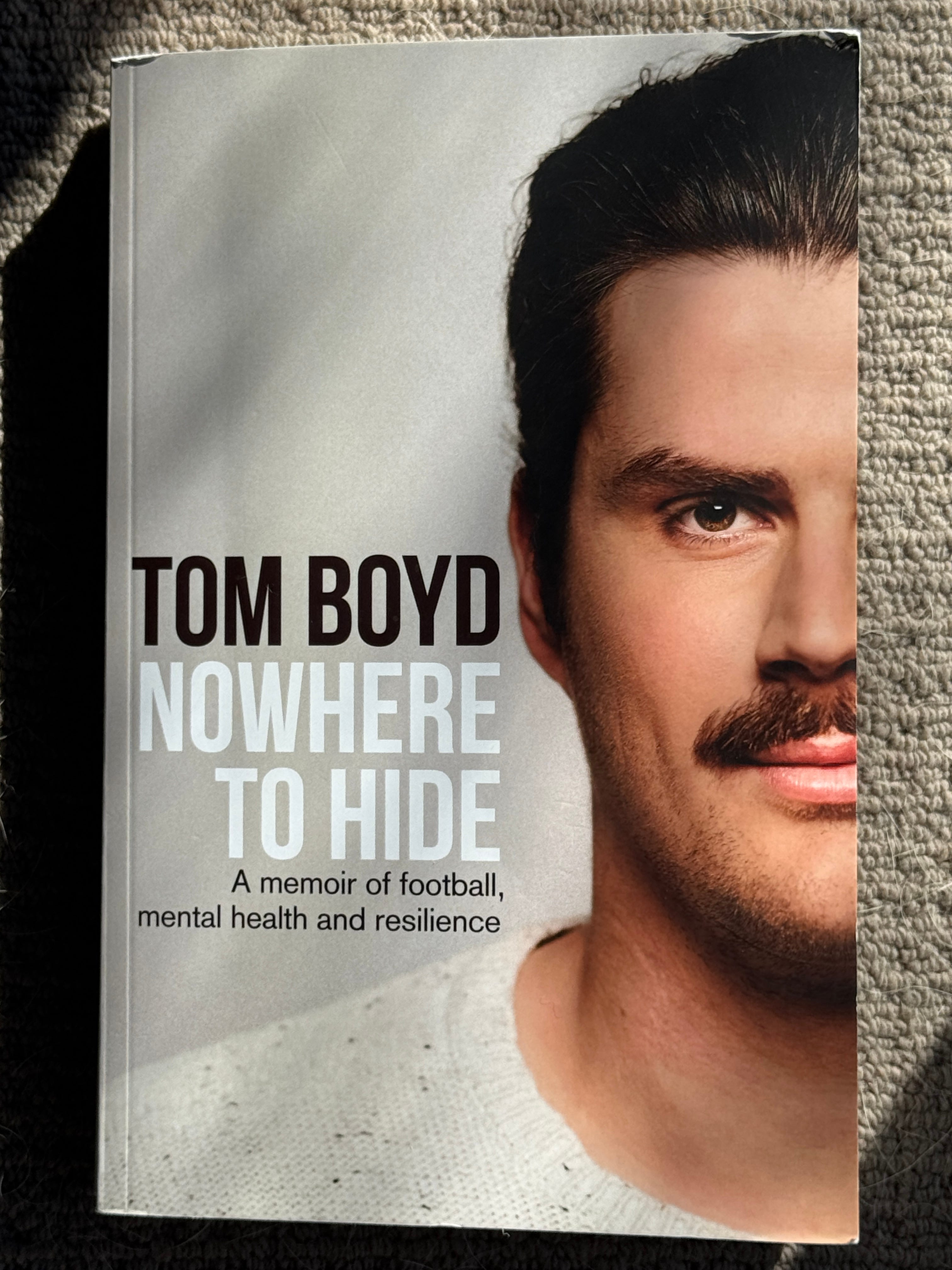
If you know me personally and you know anything about AFL, you’ll know I am a Western Bulldogs supporter. I absolutely love the Doggies and having heard Tom speak numerous times in recent years on podcasts and the like, I have been impressed by him. I have not always been a Dogs fan though (a long story in itself), so when I started out as a supporter, Tom was already playing at the club and was, as I now understand, struggling with his health, both mental and physical. His struggles were somewhat public but I don’t think the vast majority of people really understood what was happening for him.
A talented junior player who was high achieving academically too, Tom was plagued with anxiety from a young age and I would describe his relationship to the sport he started playing at age five as one of ‘love-hate’. He had talent and football brought many advantages to his life, but it was also a significant weight on him emotionally and, he says, meant he was seen as one thing (a footballer) instead of a multidimensional human. This part doesn’t surprise me - the AFL bubble might be smaller than the world round-ball football or NFL, but it is intense, particularly in Melbourne and particularly for those pegged as stars or who are paid a lot of money to play sport. Some people manage that pressure, some don’t. I don’t think the ability to do so or not is a mark of one’s character - we are not all born to be in the spotlight - but Tom certainly felt the pressure. His first year was spent at the GWS Giants in Sydney, then was traded to the Western Bulldogs.
In his second year at the Bulldogs, Tom Boyd became a premiership player; an integral part of the 2016 team, it was the pinnacle of his sport and, he thought, the answer to the anxieties that he’d lived with for so many years. Instead, the worst was yet to come, and at 23 years of age, in 2019, Tom Boyd retired from AFL, leaving behind more than two years of a million-dollar a year contract (at the time, one of the highest paid players in the league).
Tom writes with candour about his mental health throughout his AFL career. This was refreshing, as young men (and particularly athletes of notoriety) don’t speak up as often as I wish they would and the impact can often be catastrophic. While as a supporter of the club at which he achieved the ultimate ‘success’, I was disappointed that Tom retired. However, it was clear at the time and crystal clear now that his decision was 100% the right decision for his health and wellbeing.
I am so grateful that he had the courage to make that decision. I don’t think Tom would see it as courageous, but I consider walking away from the sport you’ve played for almost 20 years, huge money for a man so young and being open about the reasons why (when that honesty is still not the norm) is gutsy. You have to have a lot of faith in your instincts, you have to have good people around you and you absolutely need to be prepared for it to take time to work out what comes next. I doubt Tom thought he’d be having to consider those kinds of life changes so soon, but he did and he didn’t hide from it. I respect that.
Since retirement, Tom Boyd has finished a university degree and works in the corporate sector, while also being an ambassador for several organisations around mental health and workplace psycho-social safety. He has taken his experience and he’s using it to try to protect and support others.
The book itself is well written and as I understand it, unlike most books in this genre, there was no ghostwriter or accomplished ‘co-writer’. He’s clearly intelligent and I think he has good insight into how his health impacted him as an athlete, but also as a person, and how it affected how people saw him. They mistook crippling anxiety for arrogance; that happens a lot. I probably thought the same thing at the time, if I am honest (I cannot remember what, if anything, I thought). I am sorry people saw it that way and I hope Tom’s book and public work has helped to shift those perceptions about him and about others who suffer, too.
I also think this is a book that is a reminder to anyone who is seen as successful, in whatever industry, that no one is immune from mental health issues and that what one person considers high performance or success is not always the same as the next persons definition, and neither is right or wrong. Success is what we each define it as for ourselves. The book is also a reminder that no one is too important or ‘high up’ (nor too insignificant) to be able to seek help and receive it without question. No one should feel like asking for help is a sign of weakness - it is not. I’m glad Tom saw that he needed help and sought it.
I’m really glad I read this memoir. I feel like I have some better insight into Tom’s footy career and who he is as a person. I’m glad he wrote it.
I think it will also be a reminder to us all that when other athletes (or anyone) seems to be ‘off’, remember that none of us knows what may be happening out of the spotlight or behind closed doors. We do not always know when someone has troubles and no one should feel obliged to tell everyone their story in order to be given grace and kindness. It doesn’t matter if someone is famous or rich or otherwise. What matters is being human and remembering those people are, too.