


This review may contain spoilers so please only read on if you’re OK with that!
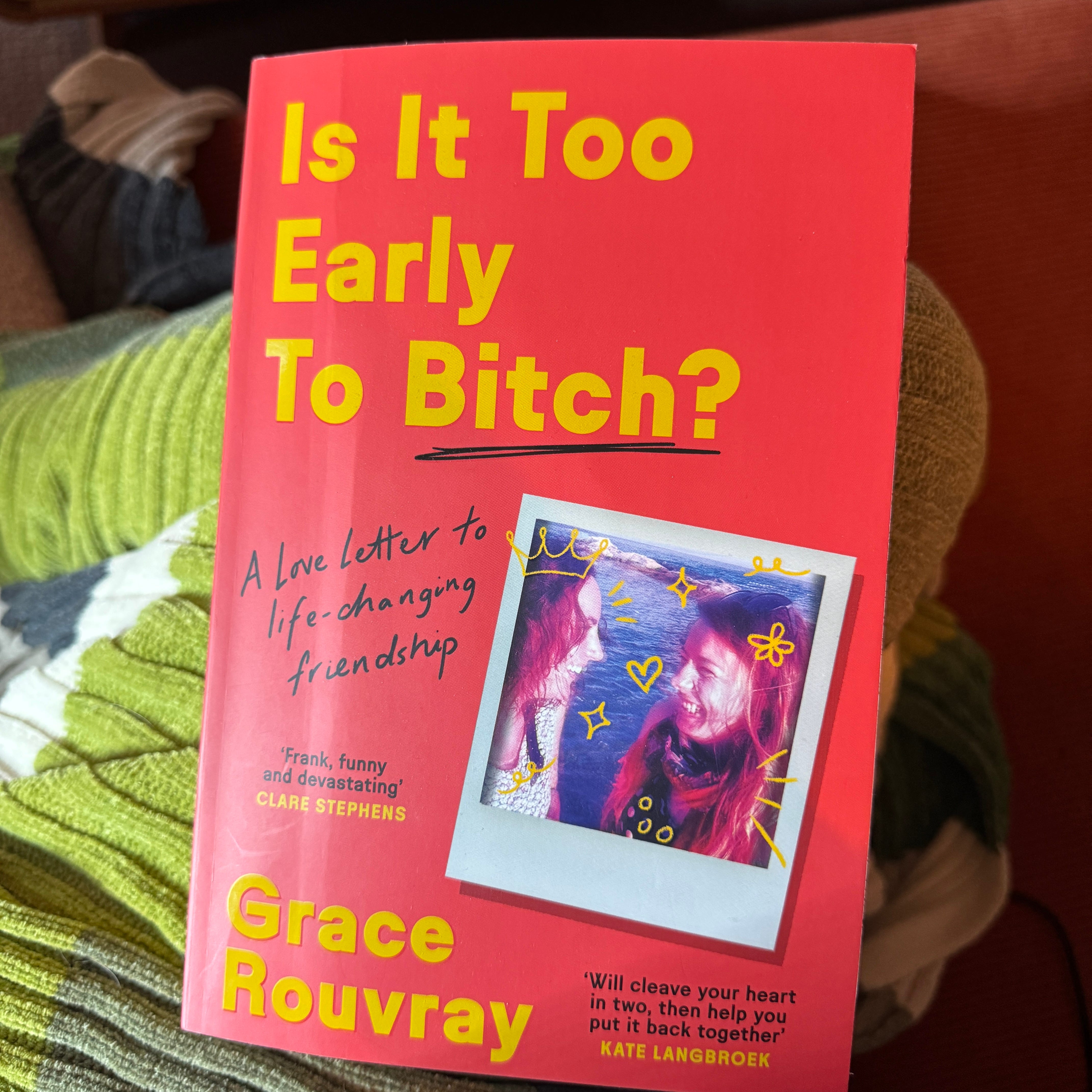
Australian writer Grace Rouvray recently launched her debut memoir, titled ‘Is It Too Early To Bitch’. The book details (sometimes in quite graphoc detail!) her friendship with Katie Lees, who she met on their first day of university and with whom she spent 13 years as the closest of friends.
The friendship never ends, but instead comes to a tragic halt when, during the Covid-19 pandemic, Katie suffered an extremely rare reaction to the vaccine and died, several days later.
The two women traverse Sydney together, studying a performing arts course, writing and performing comedy shows together and generally living like so many 20-somethings do - booze, blokes, bad jobs galore, plus plenty of fun times. Both women become extended parts of each other, and each other’s families, even when, as such close friendships inevitably do, they evolve and change, and some fault lines appear.
It was just prior to Katie’s unexpected death that one of those fault lines became more evident, but couldn’t be played out because of her death. Grace considers whether, had Katie lived, there would have been a shift in the relationship or a change unlike any before it. In some ways, I think Grace felt some guilt because of that divergence beginning to emerge. She shouldn’t. There’s no tellling how that would have happened, and as we grow up and mature, some friendships do change, even when we wish otherwise.
I think for Grace and Katie, they were also reaching a changing time in life generally - settling down, considering marriage and families, seeking greater stability. Those things are generally not at the forefront of our minds during our university years or the years thereafter, but eventually, for most, the party lifestyle wears thin and we realise we want experiences of greater substance than a bottle of Johnny Walker and a pack of Marlborough’s - despite the memories those (or other) acquaintances may have brought us. As I read the book, I did wonder if this friendship was one based too heavily on pubs and parties. Yes, many of us create deep friendships at pubs and parties, and some of the best conversations you’ll have in life often happen in those circumstances! However there is a limit to that, I think. Eventually, all the drunk deep and meaningfuls, the gossip and oversharing, the ‘fuck it’ attitude… eventually there needs to be more. Maybe it was simply reaching a point for Grace and Katie where the love was there, the connection would remain but their paths were simply pointing in different directions. It’s awfully sad, but it happens, and it is usually a sign that at least one party is growing up.
I was attracted to this book because I have had several close female friendships in my life, some of which continue and some of which, for various reasons, have ended. The grief you feel at the end of a major friendship is a unique one, often misunderstood or not understood at all. That saying about people entering your life for a reason, a season or a lifetime comes to mind: I can think of some women who I thought were absolutely going to be lifetime friendships (and who I still miss deeply), only for the seasons to be long but, ultimately, finite. It’s a different type of grief to most others, I’ve found.
More pertinently to Grace and Katie, and like so many, I have also had close friends die.
Sometimes I’ve had foreknowledge of what was coming and sometimes without warning at all. All too recently, I’ve experienced that kind of loss, and it is profound. That kind of grief is also particularly complex, because, like Grace writes in her book, being a ‘friend’ when someone dies is not the same grief as that of a partner, a parent, a sibling or a child. I would never suggest they are the same. Friendships also vary on levels of closeness, so one person’s grief as a friend is likely going to be very different to another friend of the person.
However, when you are truly a person’s best friend, and known to all and sundry as such, there’s a layer to it that is hard to place, because of the unique nature of a true BFF. Most of us are lucky to have someone as a best friend for even part of our lives, much less until death-do-you-part. You wonder if you are ‘important enough’ to sit with the family when the person who died is your ‘ride or die’ in life. Or do you reduce yourself to less than you were, so as not to offend or cause confusion? Do you have the same right to grieve deeply or for as long about the loss as those more closely connected?
This was, to me, the most interesting and thought provoking element of Grace’s memoir, and in some ways I wish she had fleshed it out more than she did. I suspect she was unable to do so, because Katie’s family included her in every aspect of their grief, including her being one of the ten people allowed to attend the funeral in person (this was during Sydney’s Covid lockdowns of 2021). I don’t think there would ever have been a moment when the Lees family considered Grace as imposing or overplaying her place in Katie’s life. For that, for Grace’s sake, I am so relieved. Not being able to say farewell would have been crushing.
However, it also meant the question posed on the back cover of whether Grace deserved to grieve as much as Katie’s family was left wonting. It is a subject worth exploration and consideration, but it maybe didn’t get the opportunity here.
Is It Too Early To Bitch? was an emotional read but well worth the time spent. It felt, to me, like a very real representation of young women at that party/youthful stage of life and reminded me somewhat of my best friend at the same time in my own life. I think it makes a solid contribution to the memoir space.