


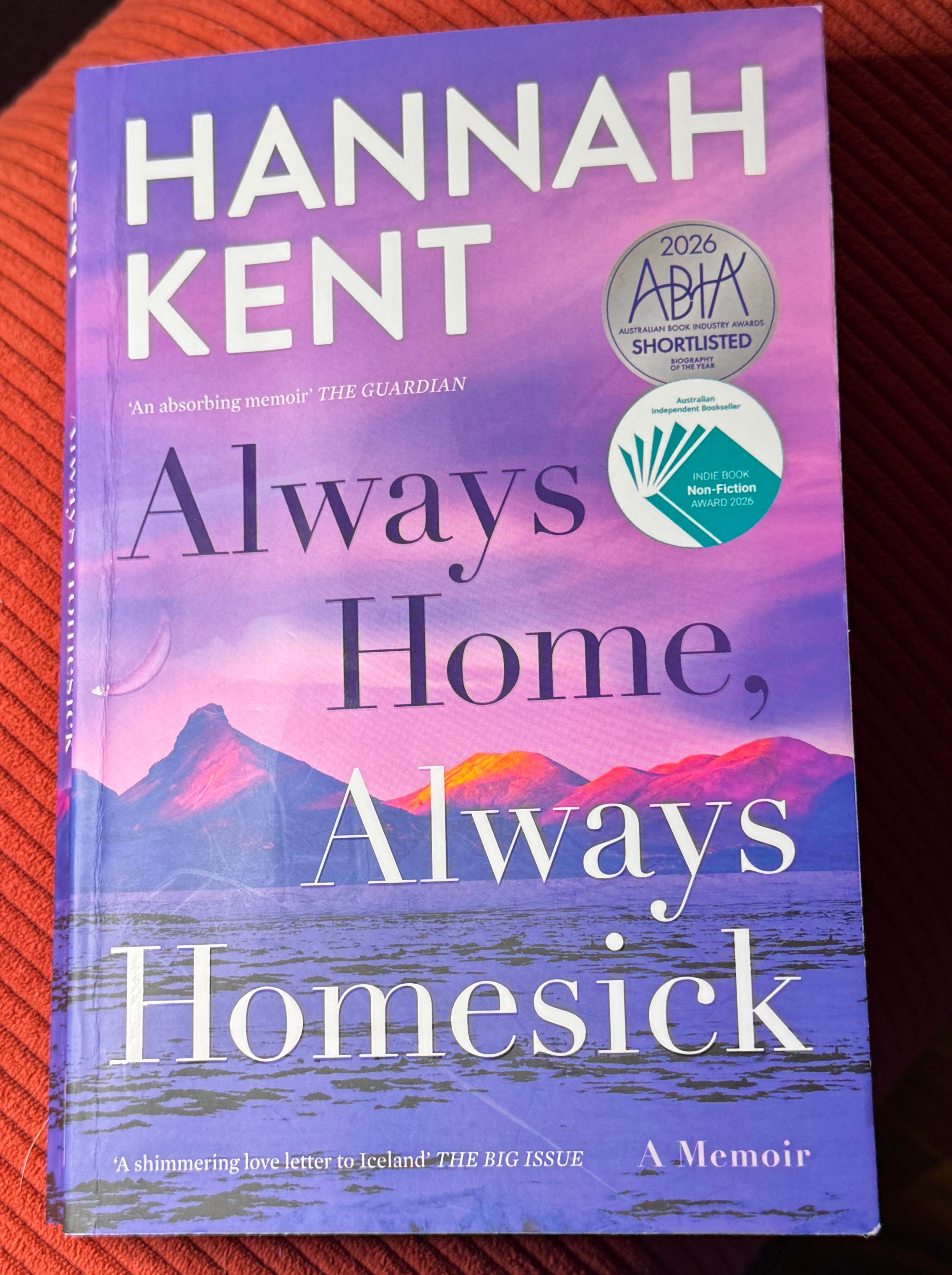
My friend Dalene bought me this book recently, after I was describing my long relationship with a far-away island and its people. I have not read any of Hannah Kent’s fiction, so I had not been prompted to pick up this memoir, but I am glad that I did so, because it was truly lovely.
Hannah Kent, author of Burial Rites and Devotion, is an Australian author. This memoir is really in two main parts: first, her time as an exchange student in a town in Northern Iceland and the challenges she faced, and second, how that and subsequent trips inspired her novel Burial Rites, about Agnes Magnúsdóttir, the last woman executed in Iceland, in 1830. That novel brought Hannah much acclaim, several awards and the freedom to continue writing.
The story of Agnes is, indeed, a fascinating one, and Hannah’s descriptions of her research and the bibliography provided shows that there is much interest in it in Iceland.
For me, the part that resonated with me most about this memoir was the relationship Hannah built with the people she came to know in Iceland, and the land itself. She has continued those relationships with host families, school friends and workmates, more than two decades after she first lived there. She has returned many times and both she and they have become intricately invested in each others lives, and created a sense of family together.
This was something I had for a very long time myself, in a place where the land is much different to that of Iceland, but is no less beautiful. My connection to that particular island came from a young age and grew each time I returned. It became a place of sanctuary and comfort, where I felt, despite being as far as geographically possible from the land I was born and raised on, like was home. This was something I physically felt in my heart and throughout me, every time I went back there. The title of this book, Always Home, Always Homesick rang particularly true to me - regardless of whether I was in Australia (the big island) or on PEI (the little island), I always felt like I was both at home, and homesick for the other. There is no doubt, too, that the relationships I formed there became sympatric with family and belonging, as Hannah’s did. While for me that connection has changed in more recent times, the connection remains intrinsically part of who I am, and I think part of the best of me. So when Hannah writes about the history of Iceland, its landscape and the imprint of the place on her - I understand it.
As a non-Aboriginal Australian, I have often wondered if my feelings of connection to Prince Edward Island and Hannah’s to Iceland, is not dissimilar to their connection to country and the lands we now call Australia. If so, although I will never fully comprehend it, I feel like I can appreciate their fight for sovereignty a little more deeply as a result.
I thoroughly enjoyed reading this memoir. It has certainly given me pause to look at Hannah Kent’s fiction and see if I might like to read it, and I was fascinated (although barely surprised) by Agnes’ story and treatment. I am thrilled that Hannah’s novel was broadly embraced, particularly in Iceland, given her deep connection to the place. This is one to put on your reading list.